Understanding AI and Its Role in Astronomy
Artificial Intelligence (AI) encompasses a range of technologies that enable machines to perform tasks typically requiring human intelligence. These tasks include learning from patterns, recognizing speech, making decisions, and solving complex problems. As AI technology has evolved, its integration into various fields has become increasingly evident, with astronomy being one of the most notable beneficiaries of these advancements.
The application of AI in astronomy begins by automating the analysis of vast amounts of data generated by telescopes and other observational instruments. Traditional data processing methods tend to be labor-intensive and time-consuming, often leading to delays in research progress. However, AI algorithms can sift through this data rapidly, identifying celestial objects and signals that might otherwise be overlooked by human researchers.
Machine learning, a subset of AI, plays a significant role in the automation process. By using models trained on existing astronomical data, machine learning algorithms can recognize patterns and anomalies in new data sets, enhancing the discovery process. For example, AI has proven effective in identifying exoplanets through the analysis of light curves, a method that monitors brightness changes in stars.
Moreover, AI is proving to be indispensable in tasks such as classification of astronomical objects, mapping the universe, and even predicting cosmic events. The integration of AI tools is not merely a supplement to existing methods but is revolutionizing how research is conducted across various domains in astronomy.
Additionally, the collaborative nature of modern astronomical research benefits from AI technologies, enabling large teams of scientists to work more efficiently across multiple disciplines. By enhancing data interpretation capabilities, AI ensures that astronomers can focus their efforts on generating new hypotheses and conducting deeper analysis rather than getting bogged down by data processing tasks.
In sum, the integration of artificial intelligence into astronomy marks a significant shift in research methodologies, offering unprecedented opportunities for discovery and understanding of the universe. As AI continues to develop, its role in this field is expected to expand, paving the way for new insights and breakthroughs in the understanding of cosmic phenomena.
Historical Context: The Journey of Astronomy Before AI
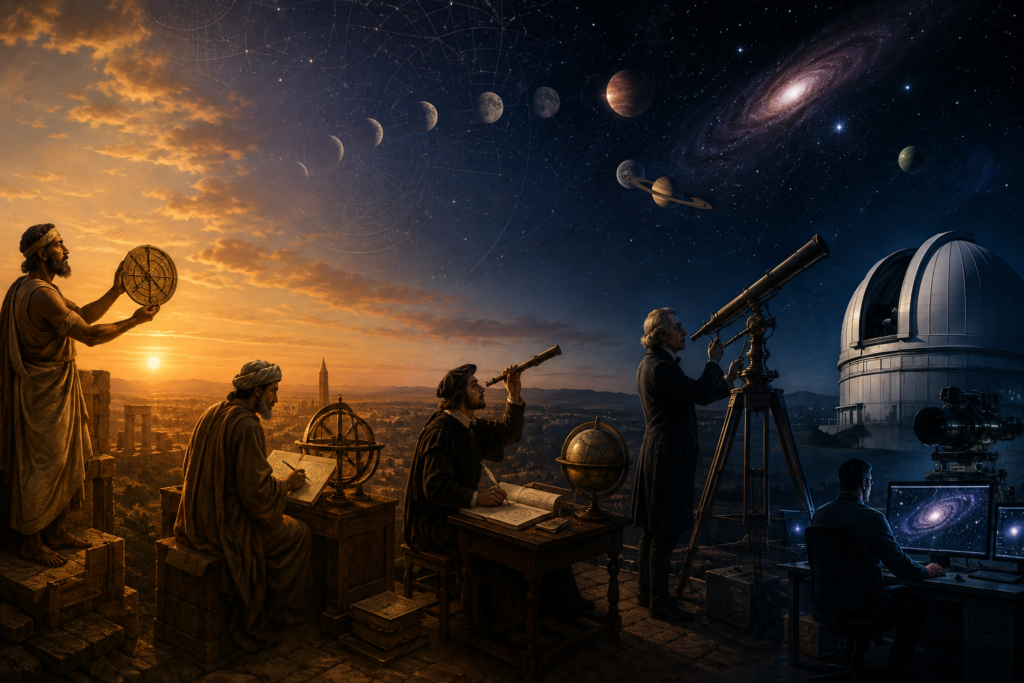
The field of astronomy has a rich history that spans thousands of years, characterized by methods and tools that have evolved significantly over time. Before the advent of artificial intelligence, astronomical research relied heavily on manual observation and rudimentary mathematical calculations. Ancient astronomers, such as those from Babylon, utilized simple tools, including astrolabes and quadrant instruments, to track celestial movements. Their meticulous records laid the groundwork for modern astronomy and enabled later scientists, like Ptolemy and Copernicus, to formulate influential theories about the cosmos.
The introduction of the telescope in the 17th century represented a pivotal moment in astronomical history. Pioneers like Galileo Galilei and Johannes Kepler used telescopes to make groundbreaking observations, such as the moons of Jupiter and the phases of Venus. These discoveries challenged existing models of the universe and spurred a scientific revolution. The ability to observe distant celestial bodies more clearly led astronomers to make significant advances in understanding planetary motion, stellar composition, and even the structure of the Milky Way galaxy.
Throughout the 19th century, the advent of photography and spectroscopy further transformed the discipline. Telescopes equipped with photographic plates allowed astronomers to capture and quantify light from stars and galaxies. This mechanism not only facilitated the discovery of new celestial objects but also enabled the analysis of their composition and distances. Notable discoveries, such as the identification of the spectrum of elements within stars, exemplified how traditional methods continued to yield valuable insights into the nature of the universe.
Despite the impressive advancements made during these eras, traditional astronomical methods were often limited by human error and the sheer scale of the data collected. As observational techniques improved and the volume of data increased, so too did the need for more efficient analysis methods. This growing complexity in astronomical research set the stage for the transformative role that artificial intelligence would come to play in the field, enhancing both research efficiency and the capacity to uncover new astronomical phenomena.
AI Applications in Data Analysis
The advent of artificial intelligence (AI) has profoundly transformed various fields, including astronomy, where it is increasingly employed to analyze vast quantities of astronomical data. Astronomers face the challenge of processing large datasets generated by modern telescopes and observatories. To manage this complexity, AI algorithms, particularly machine learning and deep learning, have become essential tools in the realm of data analysis.
Machine learning techniques allow astronomers to automatically identify patterns and anomalies within extensive datasets. These algorithms can be trained on previously classified data, enabling them to recognize similar patterns in new data. For example, astronomers utilize machine learning models to detect transient astronomical events, such as supernovae or variable stars, by automatically classifying millions of light curves collected over time. This capability to sift through large volumes of data quickly accelerates the research process, enabling scientists to focus on more complex analyses and hypotheses.
Deep learning, a subset of machine learning, further enhances this process. Utilizing neural networks, deep learning algorithms can process significantly more detailed and intricate data than conventional methods. In astronomy, these algorithms are used for image recognition tasks, allowing for the effective classification of celestial objects in images captured by telescopes. Deep learning models can discern fine details within images, such as distinguishing between different types of galaxies or identifying exoplanets transiting their host stars.
AI-powered tools, such as the AstroML library and the Lightkurve package, exemplify the practical implementation of these advanced techniques. AstroML provides a set of machine learning tools for addressing common data science problems in astronomy, while Lightkurve facilitates the analysis of time-series data from space telescopes. Together, these platforms demonstrate how AI applications are revolutionizing data analysis in astronomy, ultimately leading to more rapid discoveries and a deeper understanding of the universe.
Enhancing Observations with AI Technology
Artificial intelligence (AI) plays a transformative role in observational astronomy, significantly enhancing the capabilities of astronomers worldwide. One of the primary applications of AI technology is the automation of telescope operations, which streamlines the process of gathering and analyzing astronomical data. By employing machine learning algorithms, astronomers can automate intricate tasks, allowing for more efficient use of time and resources.
A notable advancement facilitated by AI is the ability to improve the accuracy of data collection. Algorithms trained on vast datasets can identify celestial objects and phenomena with high precision. This has led to the development of systems that can detect transient astronomical events, such as supernovae, more effectively than traditional methods. For instance, the Pan-STARRS telescope utilizes AI-driven software to analyze images and pinpoint changes in the night sky, leading to timely discoveries and better understanding of cosmic events.
Real-time observations, a crucial aspect of modern astronomy, have also benefited from AI innovations. Systems like the Zwicky Transient Facility employ AI to process vast amounts of real-time data, enabling astronomers to react swiftly to new findings. The integration of AI allows for quicker processing of data, ensuring that potential discoveries are not missed due to delays in human analysis.
Moreover, AI assists in reducing human error during observations. By implementing neural networks trained on previous astronomical data, AI systems can offer higher levels of reliability in identifying patterns and anomalies. Such advancements not only enhance observational efficiency but also broaden the scope of research by allowing astronomers to explore previously uncharted territories in the universe.
In conclusion, the integration of AI technology in observational astronomy marks a significant advancement, with automation of telescopes and enhanced data accuracy redefining how astronomers conduct their research. The collaborative potential of AI to aid in real-time observations symbolizes a groundbreaking shift in unraveling the mysteries of the cosmos.
Discovering Exoplanets with AI
The identification of exoplanets, or planets orbiting stars outside our solar system, has become significantly enhanced through the advent of artificial intelligence (AI). AI technologies, particularly machine learning algorithms, are proving invaluable in processing the enormous volumes of data generated by space telescopes and other observational platforms. By utilizing these sophisticated tools, astronomers can uncover subtle signals that may indicate the presence of exoplanets, a task that requires both precision and efficiency.
One notable case study demonstrating the effectiveness of AI in exoplanet discovery is the application of Google’s TensorFlow software in analyzing data from the Kepler Space Telescope. Researchers trained AI models to identify periodic dips in star brightness, which are characteristic of planets transiting in front of their host stars. This method not only accelerated the discovery rate but also increased the accuracy of detecting previously undetected exoplanets.
Moreover, AI’s contributions extend beyond mere identification. Its ability to analyze spectroscopic data allows for the characterization of the atmospheres of exoplanets, providing key insights about their potential habitability. For example, through the application of AI algorithms, researchers were able to examine the atmospheric composition of exoplanet WASP-121b, revealing the presence of elements such as sodium and potassium. These findings enhance our understanding of the environmental conditions on distant worlds.
Furthermore, the implementation of AI methodologies aids in reducing human error during analysis, streamlining the process of confirmatory studies. Automated systems can analyze light curves and classify various signals, flagging those that are most likely to correspond to exoplanet transits. The efficiency of these advanced techniques ultimately leads to a more thorough exploration of our galaxy.
In conclusion, the transformative role of artificial intelligence in discovering exoplanets cannot be overstated. Through advanced algorithms and machine learning techniques, AI empowers astronomers to explore territories beyond our solar system, thus reshaping our understanding of the universe and the planetary bodies that inhabit it.
AI in Cosmology: Understanding Our Universe
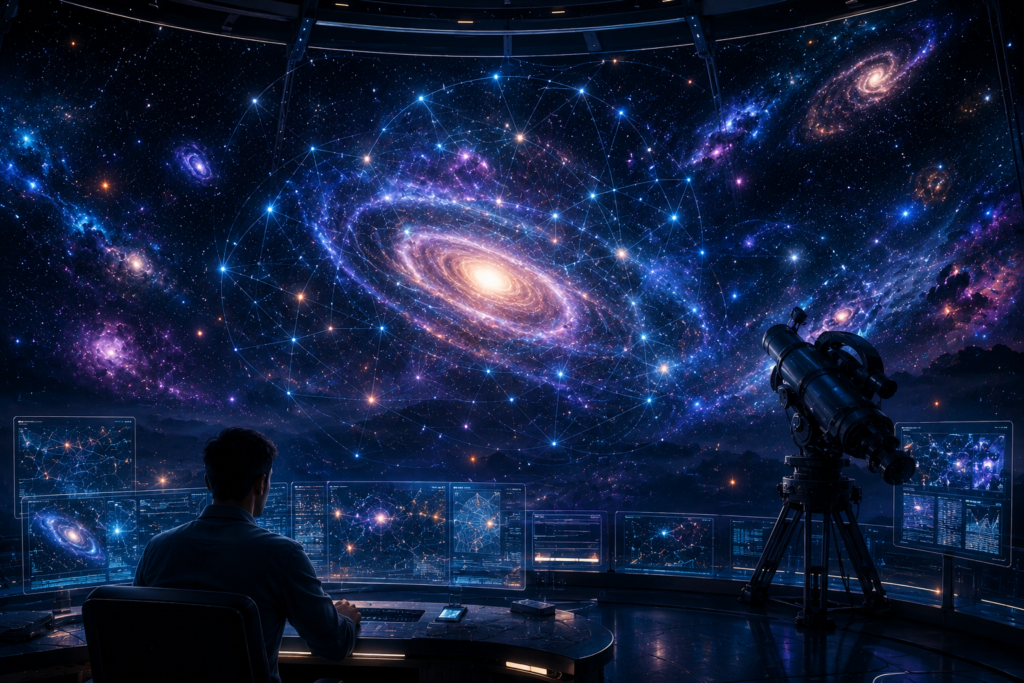
The integration of artificial intelligence (AI) into cosmological studies has revolutionized the way astronomers comprehend the universe and its myriad phenomena. By harnessing advanced algorithms and vast datasets, scientists are now able to analyze cosmic events with unprecedented speed and accuracy. The capabilities of AI allow researchers to discern patterns in massive amounts of astronomical data, enhancing our understanding of complex phenomena such as black holes, neutron stars, and the cosmic microwave background.
One significant aspect of AI’s impact on cosmology is its ability to simulate cosmic events. Traditional methods of simulation can be time-consuming and labor-intensive. However, with AI-driven simulations, the modeling of cosmic events becomes more efficient. For instance, neural networks can predict the formation of galaxies under different conditions, thereby providing insights into the dynamics of the universe’s evolution.
Moreover, AI has become instrumental in the development of new theories regarding the origin and evolution of the universe. By analyzing observational data from telescopes and other instruments, AI systems can identify anomalies and generate hypotheses that were previously overlooked. This capability enriches our comprehension of dark matter, dark energy, and other fundamental components of the cosmos.
As researchers continue to explore the vastness of space, the role of AI in cosmology is likely to expand further. The blending of machine learning techniques with astronomical research not only accelerates the discovery process but also enhances the precision of cosmological models. Through the application of AI, we are inching closer to unveiling the mysteries of the universe, leading to potential breakthroughs in our understanding of its origins and behavior.
Astrophysics Research Advancements Through AI
The integration of artificial intelligence into astrophysics has ushered in a new era of research, fundamentally changing how scientists study celestial phenomena. AI technologies enable astronomers to process vast amounts of data, which has become a pivotal aspect of modern astrophysical research. For instance, the dataset generated by telescopes, such as the Very Large Telescope and the Hubble Space Telescope, can be overwhelmingly large, encompassing billions of images. AI algorithms, particularly machine learning, are indispensable in analyzing these datasets, allowing for the efficient identification of patterns and anomalies.
One significant breakthrough facilitated by AI is in the detection of exoplanets. Algorithms have been developed to sift through light curves from distant stars, identifying the subtle dimming that indicates a planet’s transit. This has not only accelerated the rate of exoplanet discoveries but has also enhanced the accuracy of identifying habitable zones around stars. The capabilities of AI in image classification and feature extraction play crucial roles in improving our understanding of planetary systems and their potential for supporting life.
Furthermore, AI is contributing to the study of cosmic events, such as supernovae and gamma-ray bursts. Machine learning techniques process the data from observational campaigns, leading to real-time alerts for transient phenomena. This rapid response capability allows researchers to allocate telescope time more effectively and collaborate across institutions to gather complementary observations. AI’s predictive modeling also assists in simulating complex astrophysical processes, giving scientists a powerful tool to explore black hole formation or galaxy evolution.
In addition to these advancements, AI helps in refining the theoretical frameworks that underpin our understanding of the universe. AI systems can analyze existing theoretical models and compare them with observational data, thereby identifying gaps and inconsistencies. This iterative process enriches the dialogue between theory and observation, ultimately leading to a more comprehensive understanding of galaxies, stars, and the underlying principles of cosmology.
Challenges and Ethical Considerations of AI in Astronomy
The integration of artificial intelligence (AI) into astronomy presents several challenges that researchers must navigate effectively to harness its full potential. One of the most pressing issues is data privacy. Astronomers increasingly rely on vast amounts of data collected from telescopes and observational equipment. This data often includes sensitive information, and the use of AI systems to process and analyze this information raises important questions about privacy and data protection. Implementing robust data governance frameworks is essential to address these concerns while ensuring that valuable insights can still be derived.
Algorithmic bias is another significant challenge. AI systems are only as good as the data used to train them. If the underlying data is flawed or unrepresentative, the algorithms can perpetuate or even amplify existing biases. In the field of astronomy, this can lead to misinterpretations or overlooking vital astronomical phenomena. For instance, if an AI model trained on biased datasets is responsible for classifying celestial objects, it may miss crucial findings or misidentify characteristics of new discoveries, which can hinder the progress of astronomical research.
Furthermore, there is growing concern regarding the growing reliance on AI systems within the astronomical community. While these technologies have shown remarkable efficiency in processing data and recognizing patterns, they can also create a dependency that may detract from the traditional analytical skills that astronomers cultivate. This reliance can pose risks if AI systems fail or produce inaccurate results. Therefore, it is imperative for researchers to strike a balance between using AI tools and maintaining critical thinking skills to ensure the integrity and accuracy of astronomical studies.
In conclusion, while the integration of artificial intelligence into astronomy offers unprecedented opportunities for discovery, it is accompanied by challenges that must be addressed. By focusing on ethical considerations like data privacy, algorithmic bias, and over-reliance on AI systems, the astronomical community can create a framework that not only safeguards ethical practices but also enhances the overall quality of research outcomes.
The Future of AI in Astronomy: Trends and Predictions
The field of astronomy, long guided by human intellect and observational prowess, is poised for a significant transformation due to the advances in artificial intelligence (AI). As we look ahead, various emerging trends and potential advancements in AI technology may redefine how we explore and understand our universe.
One of the most promising trends is the integration of machine learning algorithms in processing the vast amounts of data generated by telescopes and space missions. With astronomical data growing exponentially, from sophisticated surveys like the Vera C. Rubin Observatory to data from space telescopes, AI has the potential to sift through and analyze this information effectively. Neural networks and other AI techniques can identify patterns and anomalies that might elude human researchers, uncovering new celestial phenomena and enhancing astronomers’ ability to interpret these findings.
Furthermore, predictive modeling, another facet of AI, is becoming increasingly relevant in the field of astronomy. By analyzing historical data, AI can enable scientists to forecast astronomical events such as supernovae or comet trajectories. Such capabilities not only aid scientists in their research but can also prepare the public and relevant organizations for extraordinary astronomical occurrences.
Moreover, the future of AI in astronomy may also involve increased collaboration between AI scientists and astronomers. This interdisciplinary approach will likely encourage innovative solutions to complex questions about dark matter, the structure of the universe, and the possibility of extraterrestrial life. As automated observatories become more sophisticated, we may see the involvement of AI in real-time research, creating dynamic responses to new discoveries.
In conclusion, the future of artificial intelligence in astronomy appears bright and full of potential. Advances in data analysis, predictive modeling, and interdisciplinary collaboration are expected to reshape our understanding of the cosmos, bringing us closer to answering fundamental questions about existence and the universe.